🔥 Keeps React and React-Native experts up to date! Join 34k+ devs for one email per week.
⚛️ This Week In React #256: Next.js, directives, TanStack, Storybook, Waku, shadcn, Rari, Astro | Navigation, EAS, Expo Modules, Gesture Handler, Screens, Nitro, IAP | ArkType, Biome, Svelte, Hono
|
Hi everyone! Filip and Krzysztof from Software Mansion here! 👋 This edition is special for at least four reasons:
That's more than enough reasons to jump straight into the content - enjoy the reading! As always, thanks for supporting us on your favorite platform:
💸 Sponsor
AI Localization That Actually Understands React Stop wasting time fighting your i18n keys. 😫 Crowdin is the perfect, automated l10n solution built for React developers – whether you're an individual or a startup. The days of manually providing context are over:
Launch a multilingual app without breaking a sweat. Focus on features, not fighting files🚀
⚛️ React
🎥 Next.js Conf 25 - Opening Keynote Next.js conf was the main event of last week, with a keynote highlighting newly released Next.js features, in particular:
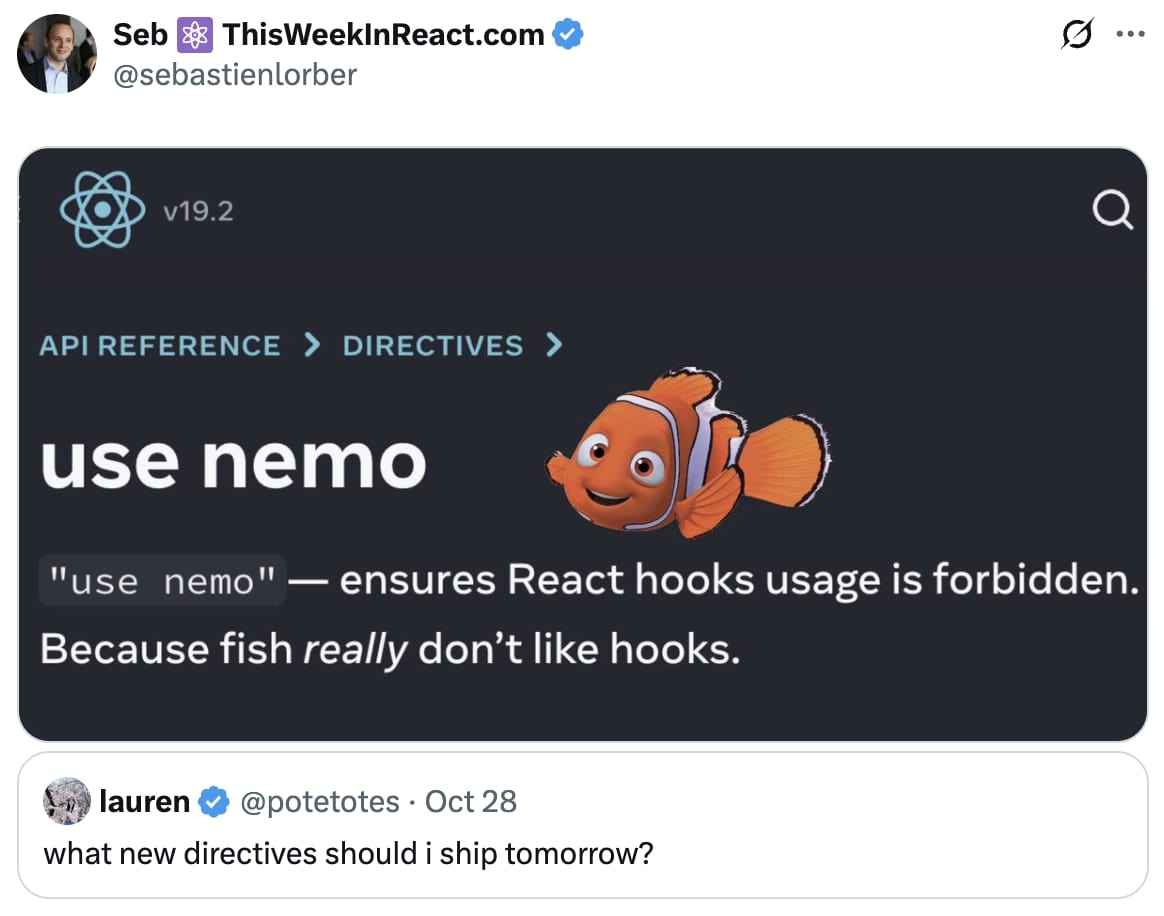
Let's take a step back to explore this new flagship Cache Components feature. It is a new opt-in flag to turn on that lets you implement the Partial Pre-Rendering pattern. The goal is to keep your app/page shells static so that navigation feels instant. It nudges you to move dynamic ( This event also led to various discussions in the community, following the introduction of parametrized directives (
💸 Sponsor
Sentry AI Code Review: Catch Bugs Before They Ship Stop shipping preventable bugs. Sentry AI Code Review brings error and performance context into your PR to catch bugs before they break prod.🧑💻
Ship code that breaks less, review with confidence, and keep production stable. Try AI Code Review in Sentry.
📱 React-Native
🇫🇷 En français
🔀 Other
🤭 Fun
See ya! 👋 |



⚛️ This Week In React
🔥 Keeps React and React-Native experts up to date! Join 34k+ devs for one email per week.

🌐 Read Online Hi everyone! Filip and Krzysztof from Software Mansion here! 👋 It’s been another challenging week for the React ecosystem. Developers worldwide have been rushing to update their React versions to patch two new vulnerabilities. This serves as a good reminder for all of us to prioritize security during testing. Fortunately, React Native remains mostly unaffected by these threats, as Server Components aren’t yet widely used in the mobile environment. We are taking a well-deserved...
🌐 Read Online Hi everyone! This week, it remains important for me to raise awareness about the React Server Components vulnerability, since an exploit is now widely available. Thankfully, we also have more positive React content to check with Fate, TanStack Alpha, React Grab, and more. It’s even hotter on the React Native side. We were patiently waiting for 0.83 to publish 😇 and it’s now out. You can now use <Activity> in React Native 🔥. Reanimated 4.2 is also out with Shared Elements...
🌐 Read Online Hi everyone! A major React 19 Server Functions vulnerability has just been disclosed. Make sure to upgrade your React 19 or meta-framework ASAP! On the mobile side, we have more positive news: RNRepo should speed up our React Native builds even more, and Shared Elements Transitions are coming soon! (unlike React Native 1.0 😅) Don’t forget to answer the State of React 2025 survey while it’s still open! As always, thanks for supporting us on your favorite platform: 🦋 Bluesky ✖️ X...