Claude writes your code. Claude reviews your code. Claude fixes the review comments. And somehow, you're the one getting paged at 2am when it breaks in prod.
Next.js 16.3 officially shipped with major engine and runtime upgrades. Long dev sessions now use up to 90% less RAM. Turbopack now supports Vite-like import.meta.glob(), and rebuilds get faster thanks to artifact caching. SSR handles up to 22% more requests. TypeScript 7 is supported through a new experimental.useTypeScriptCli option. Various AI improvements include versioned docs for agents, skills, and actionable errors. There are also new APIs such as catchError to create custom error boundaries, and next/root-params useful for i18n.
The core release focuses on Instant Navigations (built on top of Cache Components) to give server-driven apps the snappy responsiveness of an SPA. This signals a clear architectural shift for Next.js: returning to a dynamic-by-default model with fully explicit, predictable caching.
This new major version is finally here, after more than 2 years of work. It lays a new foundation for years to come, with a tree-shakable plugin architecture, state management powered by TanStack Store, new features, major performance improvements, hundreds of bug fixes, and more.
As a framework-agnostic lib, it comes with many framework-specific adapters, including new ones. The existing ones have been refreshed around a new reactivity model. For React developers specifically, it now supports React 18+, works well with the React Compiler, and unlocks more granular reads based on atoms/selectors to avoid useless re-renders.
👀 React Core PR - browser() API - Exposes a client-only react-dom API to safely suspend SSR for browser-specific components, eliminating hacky server error-suppression workarounds.
Hardcoded forms create a costly cycle: every new field, workflow, validation rule or customer-specific variation becomes another development task, code review and deployment.
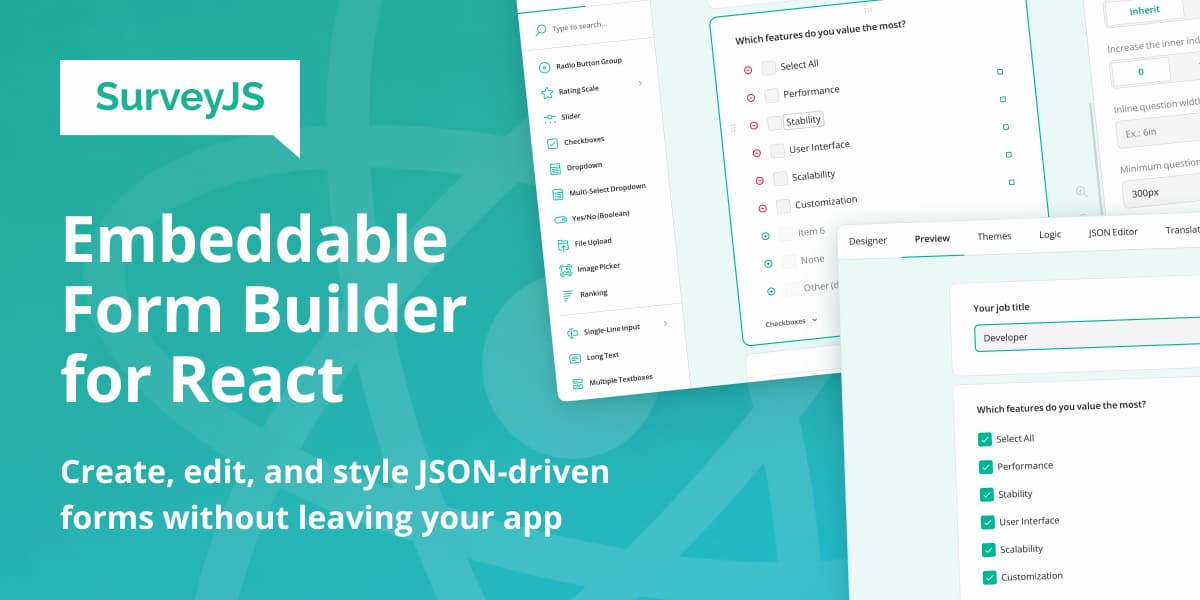
SurveyJS breaks that cycle. Developers embed a JSON-powered form builder and reusable form runtime into their React application once. Business teams can then create and update forms through configuration rather than application code.
Ship new forms faster
Reduce repetitive frontend work
Launch form changes without waiting for a release cycle
Keep full control over your backend, data, security, and branding
Your developers own the platform. Your business teams manage the forms. 🙂
🐦 Faster touchables in Gesture Handler coming soon - RNGH’s Touchable rendered ~300ms faster than RN’s Pressable in a list with 1000 buttons in one of the benchmarks, definitely worth keeping an eye on this!
📦 React Native Plain Text - A faster, lower memory alternative to use for simple texts, currently limited to static, single-style text. It’s faster than RN’s core `NativeText/RCTText according to 𝕏 the author's benchmark.
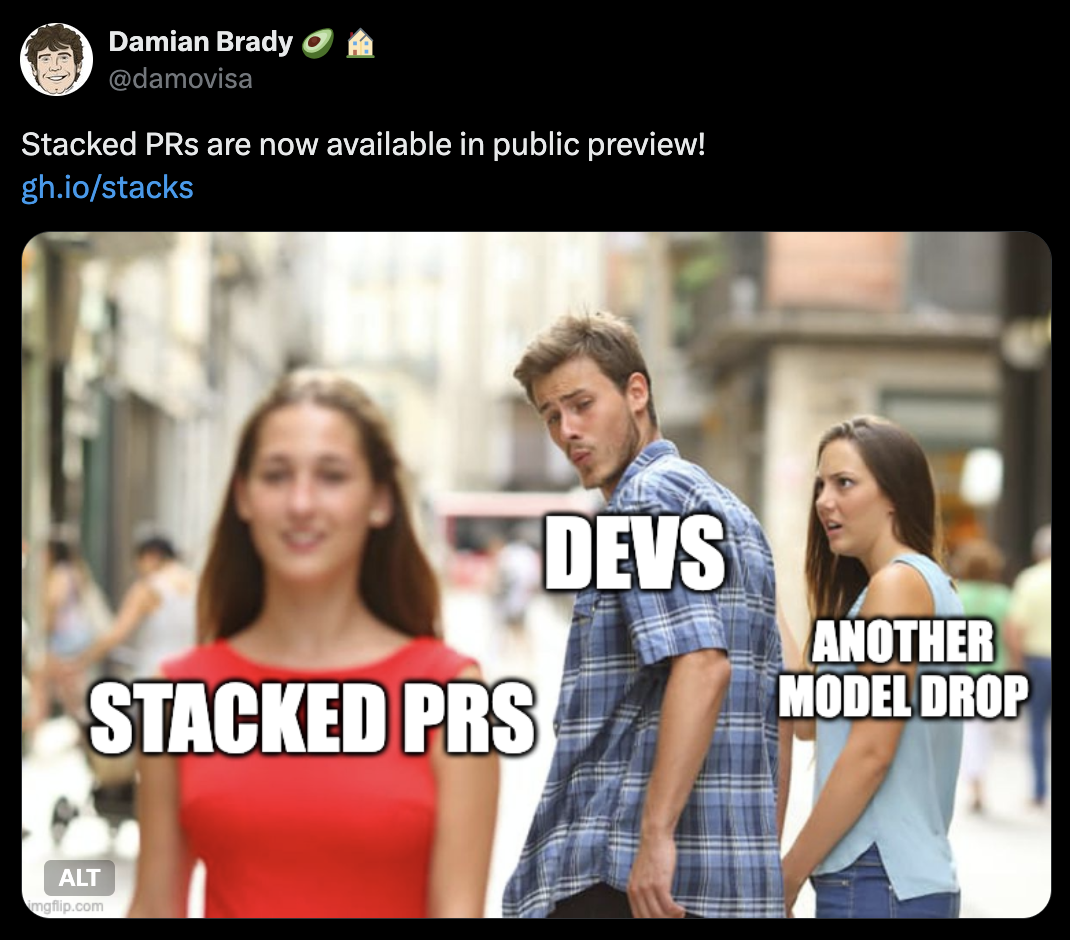
📣 GitHub stacked PRs now in public preview - Adding native PR stacking with automatic base retargeting, partial merges, and official CLI (gh-stack) integration.
📦 Flue 2.0 - “React for Agents” - introduces a hooks-based architecture (useModel, useTool, usePersistentState) that replaces static configuration with dynamic agents capable of swapping models and capabilities at runtime.
🌐 Read Online Hi everyone, Seb and Jan here 👋, earlier than usual this time 🤪 Wow, 300 issues already! Time flies, and thanks for reading along 🙏 It's a big week, with major releases from the Next.js and TanStack teams. We also put the spotlight on recent React Foundation activity. On mobile, Skia 3.0 is out! Shopify and Coinbase both recently announced moving away from React Native, a trend worth watching. Callstack officially launched an AI model specialized in React Native. There are other...
🌐 Read Online Hi everyone, Seb and Jan here 👋! This week we have 2 major releases in the React ecosystem: Panda CSS v2 and Vinext v1. On the mobile side, RN is getting support for variable font and Android Activity Result. Lynx v4 is out. Lucent is a new way to write native modules. I’m particularly excited about the TC39 meeting happening right now. Many proposals progressed, including my favorite one: Composites moved to stage 2! Let's dive in! 💸 Sponsor The React framework for MCP Apps MCP...
🌐 Read Online Hi everyone, Seb and Jan here 👋! This week is rather quiet on the web side. Astro's React integration keeps ramping up. Redux is working on significant performance improvements for large apps. On mobile, we still have a steady flow of interesting releases. Reanimated enabled its new layout engine by default. Shopify presented Helix, its internal tool to move away from RN. Xcode project format is finally moving to JSON! We asked on 𝕏: do average devs still care about React?Thanks...