Agents ship React features faster than ever. They also ship unindexed queries, N+1s, and schema decisions made at 2am by a model that will never get paged.
Fortunately, agents can fix database problems too. They just need production data, and that's what the PlanetScale MCP server gives them. Hook up an agent, and the loop looks like this:
PlanetScale flags a slow query
The agent traces it back to the code in your repo
The agent opens a PR with the fix
You review and merge
Run it once, or put it on a schedule.
Underneath it all: the fastest, most scalable cloud Postgres and MySQL, with options like PlanetScale Metal when you need peak performance. Fast databases, fast React apps.
StyleX, the atomic CSS-in-JS library from Meta, has been all the rage on X recently. This probably follows the 𝕏 Cursor migration from Tailwind to StyleX. Or maybe it’s related to Meta open-sourcing Astryx, the extensible, agent-friendly design system built on top and powering thousands of their apps for years.
Anyway, we already covered all that, so here are the recent resources to check out:
📜 Styling Linear for the future with StyleX - Linear completed its styled-components to StyleX migration. They don’t explicitly mention Tailwind but still highlight where StyleX does better: strong type-safe constraints, deterministic and performant merging of styles, styling-at-a-distance deliberately hard.
📜 A deep dive into StyleX - Hands-on introduction and opinionated conclusion: Tailwind’s terse syntax is better for humans, while StyleX's stronger constraints are better for agents.
👀 React Types PR - Types for React 19.3 - We already had a hint of what’s coming in the last issue. This DefinitelyTyped PR is still a draft but cautiously confirms the upcoming highlights. A new React DOM browser() API is coming. and will be stable for React DOM usage, designed to be extended by other platform/renderers, with React Native support likely coming later.
📖 React DOM Docs - New use(browser(reason)) API - This new API coming in v19.3 lets you mark a component as browser-only during server rendering. Must be called from a Client Component, within a Suspense boundary. There’s also a new onBrowserBailout() server API introduced for reporting.
🗓️ React Advanced London - 🇬🇧 London - 23 & 26 Oct. 40+ talks and 5+ hands-on workshops on modern React & AI tooling for React devs. A great place to catch up with the community - all inside London's historic ex-brewery. Save 10% on your ticket with code "TWIR".
📦 Bun 1.4 - The Rust rewrite is ready, alongside so many other things that the blog post probably takes hours to read, so we’ll focus on the React-related updates only. Built-in support for the React Compiler in Rust. A new Bun.markdown.react() turns Markdown into a React Element, supporting component substitution. Node.js compatibility improvements, Next.js 16 compatibility, reduced memory usage.
📦 TanStack Query 5.102 - Simplify Query Methods - An important release for TanStack Query that finally implemented its RFC to merge 6 former imperative query methods under only 2 unified APIs: query() and infiniteQuery().
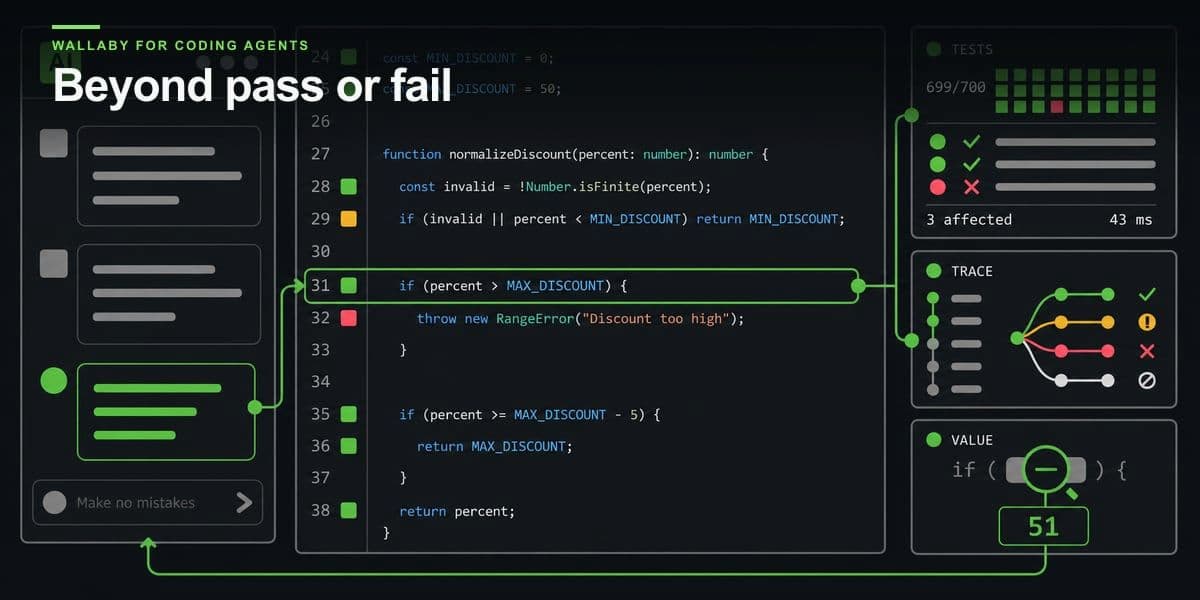
A passing test tells an agent how the run ended, not whether the code behaved as intended. Wallaby turns your JavaScript, TypeScript, and Python tests into a live runtime model the agent can inspect throughout the task.
Wallaby keeps results and coverage current as files change. With the Wallaby CLI for coding agents 🤖, agents can find tests covering a line, inspect branch coverage, follow one test’s execution path, and query runtime values in its exact context, without temporary logs or digging through terminal output.
Use Wallaby with Codex, Claude Code, GitHub Copilot, Cursor, Windsurf, and other agents locally, in containers, or in the cloud. Wallaby for coding agents is free for everyone during the beta.
React Native 1.0 is still on the horizon, but to respect Semantic Versioning, it first needs to clearly define its public API surface. Following the work on stable JS/TS and Java/Kotlin APIs, it’s now the turn of the C++ APIs to be clarified.
Until now, there has been no clear distinction between public and private C++ APIs. As a result, community libraries and frameworks sometimes depend on APIs that were never intended to be public. This can cause libraries to break when upgrading React Native, or force the core team to preserve backward compatibility for internal APIs to avoid breaking the ecosystem.
This RFC introduces a new three-tier visibility model for C++ APIs:
Public: Stable within major versions, safe for libraries to depend on, and exposed through a single umbrella header.
Framework: Stable within minor versions. Regular usage emits a suppressible warning.
Private: No stability guarantees. Regular usage emits a suppressible error.
There’s existing tooling to take a snapshot of existing C++ APIs, and it will be adapted to take into account this new visibility model. All this will greatly help stabilize the C++ APIs and ensure React Native doesn’t ship unintended breaking changes.
Work is already in progress to apply this visibility model to all C++ APIs. This will be rolled out gradually, first opt-in through a RN_STRICT_API build flag, then opt-out after a grace period, giving time for the public API consumers to migrate to the new umbrella headers. Most APIs have already been categorized, so if your library depends on private or framework APIs, now is probably a good time to chime in.
👀 React Native PR - ResizeObserver - A Web API spec-compliant implementation has been recently merged, but still behind a flag. More capable than onLayout.
🗓️ React Native Connection - 🇫🇷 Paris - 24 Sept. Last call to grab your ticket and join the React Native community in Paris! Get a 15% discount with code "TWIR".
📜 Pasting images into TextInput should not be this hard - Pasting an image into a chat input is surprisingly hard. Wrapping TextInput turned out to be the best decision to avoid reimplementing well-known behaviors and APIs.
📜 Gesture Handler's Touchable: The Button We Wish We Had Sooner - The old nice button components are deprecated and replaced with the new Touchable component. Per-state scale, opacity, and underlay with custom transition times. Hover support on mobile via mouse and pencil, all without writing a single animation.
👀 CSS - Class Prefix Selector - Not implemented anywhere yet, but CSS will support .prefix-* selectors, letting you target multiple CSS classes at once.
📦 vgpu - WebGPU library, designed for agents - The creative library Vercel developed to ship performant shaders. Agents can verify their work with a CLI, even in sandboxes without a GPU.
🌐 Read Online Hi everyone, Seb and Jan here 👋! TanStack Start 1.0 is finally stable, a client-first alternative to server-first React frameworks. On mobile, Expo will maintain React Native Web under the React Foundation. Tamagui v3 and One v2 are out. React Native 0.88 is at RC5, so it should land very soon! Deno is joining Cloudflare. JPEG XL lands in Chrome and Firefox. TypeScript is getting ported to Rust, twice. Let's dive in! 💸 Sponsor TrustedRouter: Your app. Your models. Your privacy....
🌐 Read Online Hi everyone, Seb and Jan here 👋, earlier than usual this time 🤪 Wow, 300 issues already! Time flies, and thanks for reading along 🙏 It's a big week, with major releases from the Next.js and TanStack teams. We also put the spotlight on recent React Foundation activity. On mobile, Skia 3.0 is out! Shopify and Coinbase both recently announced moving away from React Native, a trend worth watching. Callstack officially launched an AI model specialized in React Native. There are other...
🌐 Read Online Hi everyone, Seb and Jan here 👋! This week we have 2 major releases in the React ecosystem: Panda CSS v2 and Vinext v1. On the mobile side, RN is getting support for variable font and Android Activity Result. Lynx v4 is out. Lucent is a new way to write native modules. I’m particularly excited about the TC39 meeting happening right now. Many proposals progressed, including my favorite one: Composites moved to stage 2! Let's dive in! 💸 Sponsor The React framework for MCP Apps MCP...